Monday, August 30, 2010

On the Use of French in Rwanda


N.B.: I was recently asked by my former GW French professor to comment on how my degree in French has assisted me in work overseas. What follows is a reflection on the subject.

A former Belgian colony, Rwanda is amidst a national transition from French to English as it integrates into the anglophone East African Community and seeks to engage China, Japan, the US, Middle Eastern and Western European countries as partners in development. My ability to read, write, understand and speak French has nevertheless been extremely useful since arriving here in 2009. In my role as a language mentor, I teach and tutor English to adult district leadership and the teenage girls at my school. I am constantly drawing on analogous grammatical structures to explain the usage of English verb tenses (e.g. simple past/passé composé, past continuous/imparfait), as most of my students have a working knowledge of French but have had little exposure to English until recently. Teaching vocabulary, I naturally point out cognates, which is generally followed by an ‘aha’ moment or a sigh of relief (one less new word to learn!)

French has helped me in my study of Rwanda’s local language, Kinyarwanda. The structure of this Bantu language akin to Swahili has little resemblance to French, but there exist many cognates between the two -- generally words in Kinyarwanda that have been adapted from the French name. Some food examples include inanasi (ananas), isucari (sucre), karoti (carotte), ibyeri (bière), coca and avocat. I feel more confident about learning new languages (Kinyarwanda and Swahili) since I’ve done it before (French, Latin and Italian), and am fully conscious of how many doors it opens in terms of cultural integration. Rwanda and Burundi are distinct in that the two regions have spoken only Kinyarwanda for hundreds of years, while neighboring countries like the DRC are home to hundreds of local languages and French serves at the unifying language across the country. This means that a Congolese from Goma (Eastern DRC) could meet a Congolese from Kinshasha (Western DRC) and have no means of communication other than French.

In Rwanda’s transition to English, I’ve had many opportunities to translate documentation from French. This includes government issued chemistry and physics curricula, official correspondence at the Bugesera District office, and the 5-year strategic plan of a primary school operated by the francophone Frères Maristes, which will be used to raise money from African, European and American supporters of the school. My ability in French has also been integral to my work at the district health centers, where I was asked to report inventory of supplies and interview the (francophone) health directors to find out how NGOs operating in my district can be of best assistance.

Apart from my work, I use French regularly at the market, when negotiating the price of a bike taxi or moto ride, and in accessing bus transport across the country. Understandably, using Kinyarwanda yields the best price, but numbers can be very complicated; cela m’arrive petit à petit. The times I’ve been perhaps most appreciative of my ability in French are when using it to get to know Rwandese and their extended families; when invited to a home to celebrate a new birth, share a meal or attend a dowry ceremony. My best friend here is Rwandan and he became a friend because we both speak French. These days we alternate between French, English and Kinyarwanda, but this is just one of the many ways that French has connected me to the world beyond our borders.

Thursday, April 1, 2010

Senior Seminar: General Papers (...or, how to think critically about the world around you)


This term I have been teaching a course called General Papers to the entire Senior 6 (grade 12) class at Byimana School of Math and Sciences, located 1 hour southwest of Kigali. With my housemate and co-teacher Rachel, we were responsible for teaching eight class periods/week to the 180 students of the senior class, filling in for the students’ full-time Rwandan teacher who is on extended sick leave. I’ve felt lucky to teach at Byimana as it is regarded as one of the top high schools in Rwanda, consistently fostering some of the highest scorers on the national exam. Our organization has a partnership with this school that is administered by the Marist Brothers, as the longtime headmaster, Brother Stratton Marisaba, is one of Maranyundo’s Rwandan school board members.

Like the girls at Maranyundo, the students of Byimana are extremely motivated, inquisitive and diligent in their studies – among the best and brightest in the country. In the past, many Byimana students have received the prestigious Rwandan national university scholarship or have been accepted on scholarship into universities in the US, Europe and neighboring countries within the EAC. As it is a school for advanced students of math and science, located in a country where traditionally girls were expected to remain at home, about 1/3 of the students are girls. While my impact on girl’s education may be less direct at Byimana, I find that I’m promoting Maranyundo’s mission in interactions with students, faculty and staff both inside and outside the classroom, encouraging strong leadership, respect and responsibility among these young Rwandan girls and boys who will (God-willing) enter university and, soon after, the workforce.

General Papers debuted in the Rwandan national curriculum just two years ago and is now mandatory for all students in the 10th-12th grades, based on a model developed several years ago in Uganda and Kenya. The goal of the course is to encourage students to think critically about a variety of topics relevant to today’s changing world through class discussions, presentations and writing assignments. The course encompasses exposure to a number of topics relevant to citizens of Rwanda and the globalized world. These topics include current news/events, demographic growth and development, science and technology, religion, health and disease control, gender, human rights, good governance, tradition and modernity, love, marriage and other relationships, unity and reconciliation, Vision 2020 and more. While one school term is understandably not enough time to cover all of these topics, with my co-teacher Rachel we broke the class weeks into themes and facilitated discussions, in-class presentations and writing exercises regarding the subjects that follow.

Rwanda’s Integration into the East African Community
Example class assignment:
In groups of four, discuss and then create a word web on one of the following questions:
1) What are the positive aspects of political/economic integration into the EAC?
2) What are the negative aspects of political/economic integration into the EAC?
3) What other models of this exist in the world? What do you know about them? How are they similar/different from the structure of the EAC?
4) What do you think of adopting a common currency?
5) What is the significance of language in forming the EAC?
Personal Essay: Given the opportunity, would you attend university or accept a job in a country outside Rwanda, within the EAC or beyond?
-Why/why not?
-If you could choose, where would you want to go, and why?
-What challenges might you face? Consider differences in culture, environment, family, friends, language, food, governance, etc.
-What are some advantages/disadvantages of living abroad?

Religion in Society

Individually – in class writing:
1) What roles does religion play in Rwandan society?
2) What role does religion play in your life?
Groups discussions:
1) Why are there tensions between Christian and Muslim cultures?
2) Which major events have illustrated or contributed to these tensions?
3) What steps could be taken to reconcile these tensions/problems among cultures? Which steps have been taken?

Women in Society
(International Women’s Day 8 March 2010)
Although women perform 2/3 of the work in the world, they receive only 10% of the income and own less than 1% of the property (UN 2005)
Based on this statistic and other indicators, women face many inequalities in today’s world. Working in groups of 8 with a focus on one of the fields A-F (A - Education, B – Business and Entrepreneurship, C - Science and Technology, D-Health: Personal, Reproductive, Family and Community, E – Government and Leadership, F – Family Roles), answer these 3 questions:
1) How have womens' roles changed in Rwanda in your group’s field in the past 15 years?
2) In what ways must these roles continue to change to promote increased gender equality and social development?
3) What are some of the major challenges women in Rwanda and worldwide face in your group’s field?
In class essay:
“The struggle for gender equality has improved the status of women in Rwanda”. Do you agree or disagree with this statement? Use examples to illustrate your argument.

Rwanda’s Vision 2020
Essay:
Which of the goals of Vision 2020 do you think are achievable by 2020? Why? Which goals do you think may take more time? Why? Use examples to illustrate your argument.

In promoting Maranyundo’s mission at Byimana, we have been welcomed by the Marist Brothers and greater school community as an invaluable language resource in this time of transition in Rwanda. We have enjoyed getting to know the Rwandan faculty and the Marist Brothers living/working on the school campus, who often approach us with questions about English vocabulary, pronunciation, and in Kate’s line of work, best teaching practices. Additionally, I am currently assisting the headmaster of Byimana Primary School in translating the school’s 5 year Strategic Plan from French into English, created in accordance with the Millennium Development Goals, MINEDUC’s 9 Year Basic Education program and Vision 2020.

Thursday, March 18, 2010

St. Patrick's Day in Kigali


Abanyakigali / Kigali Lifers,

There will be a celebration of St. Patrick's Day on
Wednesday March 17th at Salt & Pepper (aka "Cohan's
Pub," the Irishized name of Kokan the Indian owner!) in
Gakinjiro, Kigali city centre. Saint Patrick's Day (March
17), most of ye will know, is the national holiday of
Ireland, and a celebration of drinking and craic
(Irish-style revelry) the world over.

There will be no admission charge and "Irish" American DJs
will be spinning their Celtic MP3s well into the wee hours.
Guinness, Baileys, Jameson and Bushmills will all be in
plentiful supply at reasonable prices (as well as Mutzig,
Primus and Amstel, of course) and mzee Cohan will be serving
up roast potatoes (the reason ibirayi are called "Irish"
potatoes!) @ 100RFr each, brochettes @ 500 RFr
each, and authentic Irish-Indian samosas for 250 RFr each.
So comecelebrate in the great Irish(-Indian- Rwandan)
tradition the great Saint, Patrick was supposed to be!

Time: Traditionally celebrating St. Paddy's Day starts in
the morning but feel free to come anytime, and probably
because this year it falls on a Wednesday most (working and
late sleeping) people will come from say 6pm onwards...
Place: Salt & Pepper ("Chez Cohan"), located just
opposite Gakinjiro's hardware market in the centre of
Kigali(Gakinjiro mu mujyi, hafi Kwa Gasasira - just where
the Nyamirambo road meets town).
Date: Wednesday 17th March (aka St. Patrick's Day)

Hope to see ye all there
Sláinte


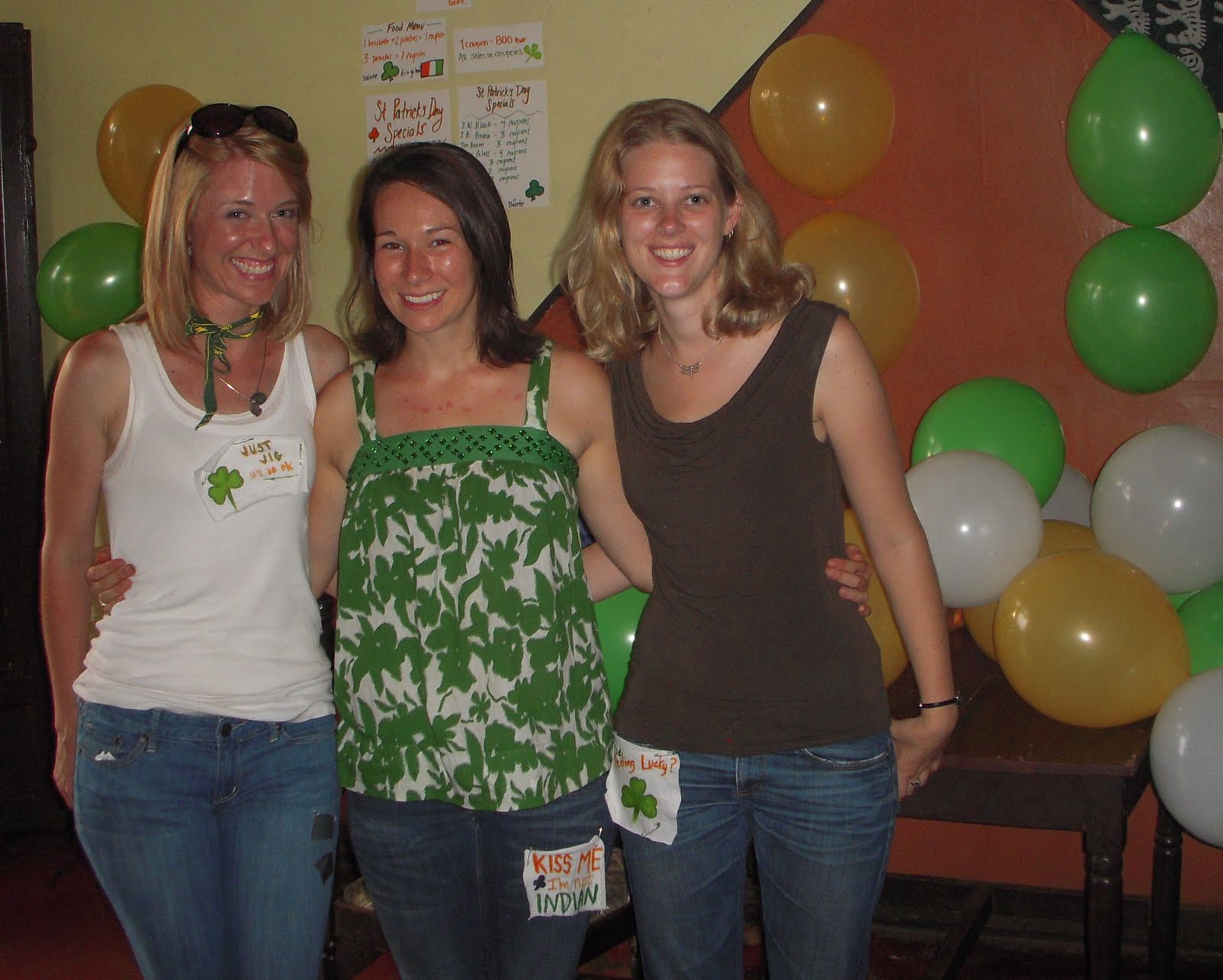
This year we celebrated St. Patrick's Day in style by planning a party - initiated by our fun-loving Indian friends - at Salt & Pepper, a small Indian Restaurant turned Irish Pub (for the sake of the event) located in town. We decorated the venue with green, white and orange (technically yellow) balloons, set up a rocking sound system featuring the beats of Dropkick Murphy's, U2, Bob Marley, Jay-Z, Lady Gaga ("just jig...it'll be okay") and others, created paper flags that accidentally honored Cote d'Ivoire (orange, white, green in that order) instead of Ireland, and enjoyed a night of celebrating St. Patel. I mean, St. Primus...no, St. Patrick.

While this description may make us party-planners sound a little resourceful, we were, in fact, a lot resourceful. As you can imagine, living as a volunteer in a developing country fosters this quality in one's self. An excellent example of our ingenuity put to action was the creation of 3x5 foot "Irish" flags. One week prior to the party, Rachel and I visited Kimironko Market, the largest and most diverse market in Rwanda. Here you find buyers and sellers of banana, rice, green peppers, cooking oil, shoes, clothing, cell phones, adaptors, empty bottles, fabric, baskets, carvings, pineapples - almost anything you can purchase in Rwanda exists here. We spent about an hour roaming the seemingly endless stalls of patterned African fabrics and selected three (in the rough color scheme of green, white and orange) for our Afro-Irish flags. Below is a photograph of one of the two the we patriotically sewed and proudly displayed at our party.

Monday, March 8, 2010

la Dotte et le Mariage


Dowry
This month I attended the dowry ceremony and wedding of a Rwandan colleague, Lydia Mitali. The purpose of the dowry is for the family of the groom to present gifts and other offerings, the greatest of which includes one or more cows, to the family of the bride. While these gifts are given to the family not exactly in “exchange” for the bride, the wedding is considered the end of the bride’s time as part of her birth family, and the start of her life with her new family: that of the groom and (eventually) her own. The dowry ceremony takes place on the property of the bride’s family, which for Lydia is located on the hillside of a rural village in the north, on the Rwanda-Uganda border. The set-up of the outdoor space included large decorated tents and folding chairs to accommodate the invited family and friends, many of whom (myself included) traveled hours by bus, bicycle or foot to attend. Neighboring villagers also attend the ceremony but sit or stand along the side as priority of chairs is given to invited guests.

The affair lasted several hours, and as it was in Kinyarwanda I can’t describe in full detail what took place. In essence, though, the ceremony is a kind of bartering of different gifts such as fruit, wine, fanta, and handcrafted baskets, followed by the “discovery” of the bride and the presentation of each bridal party. This happens in the form of a long conversation between the elder male members of each family, in which one elder (who is as a rule not the father of the bride or groom) acts as the spokesman for his respective family.

As it is a kind of dialogue, interrupted by various gestures of the prescribed participants (and in that way, almost theatrical), I found the ceremony much more interesting than most of the other lengthy Kinyarwanda speaking events I’ve witnessed since living in Rwanda. One part of the ceremony that I know I won’t forget was the discovery/recognition of the bride component, in which the family of the groom is presented with several female audience members and has to choose and testify that Lydia is in fact the most beautiful and worthy among them. First, a very old woman is brought up to the front, and presented by the bride’s family as if she were Lydia. The groom’s family must discuss and eventually refuse her. Next, a very young woman is brought to the front in a similar manner, which, wouldn’t you guess, happened to your truly! After a few formal greetings and snapped pictures, the elder spokesman handed me a microphone and asked me, “Witwande?” (What is your name?) Although I was nervous standing alone in front of so many watchful eyes, not understanding in the slightest why I was asked to come up, I proudly responded in my best Kinyarwanda, “Nitwa Kerry”

…followed by a thunderous round of laughter from anyone over the age of about 8!?! I smiled bashfully (now even more confused), re-shook the hands of the elders and was prompted to return to my seat. Shortly after, my friend Jackson told me that now everyone in the crowd was really enjoying themselves, having a grand time because of my response. He explained that whoever goes up there is supposed to respond “Nitwa Lydia,” pretenting to be the bride! To my own defense, they didn’t ask the old lady before me anything when she was presented! I was even more embarrassed learning this, but happy to see that in a small way I had added some spice to the afternoon. (As a post script, I told the story of what happened to a Rwandan friend later that week, and he consoled me with the fact that often at that point in the ceremony they will choose a very young girl, who - not knowing any better - also responds with her own name).


Wedding
The wedding this past weekend was a more familiar event, particularly since it was not my first in Rwanda. It began with a two-hour service in Lydia’s Presbyterian church in Kigali, in which she and her soon to be husband exchanged vows - - alongside another set of nuptials. This is common in Rwanda, and usually there will be between two and five (at Catholic churches, up to seven) couples getting married on the same day, in the same church, at the same ceremony, with no known relation to each other. (Not quite what I envision for my wedding some day, but customs are customs). Another difference in the ceremony was that once the couple has exchanged vows and is pronounced husband and wife, the groom slowly, meticulously rolls up his bride’s veil and the couple kisses each other on the cheek. This gesture may seem understated by American standards, but (witnessing it twice) I found it quite elegant.

In terms of attire, Rwandan brides wear the same type of elaborate white dress as is our custom at weddings in the West, while at the dowry ceremony, the bride wears a different colored dress of her choosing. Bridesmaids are color coordinated and wear similar style dresses as those common in western weddings, but they respect the custom of wearing a dress that is at least knee length. Female guests often wear a mushanana, the Rwandan patterned long skirt and sash combination as shown in the pictures below. Men also sport formal attire - usually black suits and ties - and the groomsmen color coordinate their ties to match the bridesmaids’ outfits.

The church service was followed by pictures at Kigali’s renowned Serena Hotel, and the reception in the function hall of another hotel on the other side of town. The set up of the reception is very different than that of an American wedding: instead of sitting around tables, people sit in rows of chairs facing a central stage area, where the bridal party and their families sit at ornately decorated tables. No meal is served, but soft drinks and beer is offered, and after the cutting of the cake, each guest is presented with a small piece. As the reception is comparatively minimal on food and drink costs, Rwandans will invite hundreds of people to the reception to celebrate the newlyweds.

Like the dowry ceremony, the reception is quite formulaic: it includes traditional Rwandan singing and Intore dancing by hired entertainers, presentations of the honored guests on stage, speeches by family members and friends, and the offering of gifts to the couple. Collectively among the American/Rwandan faculty of Maranyundo, we presented our dear friend Lydia gifts of house furniture along with a specially wrapped joke gift: a stack of her students’ notebooks and a red pen for grading. As she opened this gift, we informed the audience that even on her honeymoon, Lydia can’t leave her responsibilities as a teacher behind.

In all, it was a lovely day and a wonderful celebration of our dear friend’s new beginning.


Friday, February 5, 2010

Return to Rwanda, via Kigali


After three fantastic months of vacation in Paris, Boston, Fort Lauderdale, DC and New York, I’ve returned to the African continent with a renewed sense of energy and purpose. In light of Rwanda’s transition to English, the Maranyundo Initiative is expanding its English tutoring and teacher training services to include other schools in Rwanda, including the FAWE (Forum for African Women Educationalists) School for Girls in the Kayonza district, as well as the Biyimana School of Sciences in Gitarama. This year I’ll continue my work as a language mentor at Maranyundo and these schools, in conjunction with our teaching coach, Kate, and two new English language mentors. In order to more easily access these schools, we’ve moved from our faculty residence in Nyamata to a new residence in the Kicukiro district of Kigali.

Even in a few months time I’ve noticed many changes in Rwanda, especially felt in Kigali. First of all, the landscape of the country is several shades greener than it was when I left, which marked the end of the dry season. Many of the premier billboards in Kigali, such as the Mutzig (Rwandan beer) advertisements have kept their image constant, but changed wording from, for example, Le Gout de la Reussite to The Taste of Success – demonstrating a marked difference in the country’s official language. Other changes I’ve noticed include increased access to telecommunications – more internet cafes with functioning computers and internet, and (in Kigali) a handful of coffee shops that offer wireless connections. While MTN and Rwandatel are still the main cell phone service providers, marketing and competition for telecommunications has also increased, specifically for TiGO, which offers cell and internet service through USB modems that connect easily to PCs and Macs. Even in some of Kigali’s grocery stores, every week brings new surprises. City Center’s Simba supermarket, for example, now sells not only food products, wine, liquor and household cleaners, but also party goods, electronics, furniture and even DVDs...however questionably authentic the version may be. Another neighborhood grocery store, Ndoli’s, has gone from selling cereal like Kellog’s Corn Flakes, Frosties and All Bran (manufactured in Dubai) from $12/box to around 5, and now sells not only the British (Kenyan manufactured) varieties of Cadbury’s chocolate, but also Toblerone, Snickers, Mambas and Twix! Markets seem to have grown exponentially in the past several months in Rwanda, particularly on imports from the Middle East and China.

Among Rwanda’s Vision 2020 goals are to boost its GDP sevenfold, find paying jobs for half of Rwanda’s subsistence farmers (who currently comprise 90% of the adult population), and turn the small, landlocked country into an African center for technology and services. According to the CIA World Factbook, Rwanda’s 2008 real GDP growth rate was a remarkable 11.2%, ranking number 7 out of 217 countries! As far as I can tell, this jewel of a country is on its way to meeting its aspirations.
Kate and me with Maranyundo's history teacher, Lydia, at her dowry ceremony in her home village, bordering Uganda

How to help Rwanda

Listed below are ways to contribute to causes that I’m involved in. Please leave a comment or email me with any questions, and thank you for your support!

Theo Scholarship Fund

This is a private scholarship fund to benefit a Rwandan co-worker (non-teaching member of the administrative staff) at the Maranyundo School, so that he may pursue a bachelors’ degree in public administration at a university in Kigali. The cost of one year of tuition in Rwanda is about $1000, a small amount for American standards but prohibitively expensive for most Rwandans - including this individual - even after years of working. My American co-workers and I are raising $4500 to cover the costs of four years tuition plus registration and wire transfer fees. Since November 2009, we have collected $1600. Any amount you are able to contribute is GREATLY appreciated. An independent accounting of all funds collected will be made available on request.
To Donate:
-Mail checks made out to “Kerry Ann Dobies/Theo Scholarship Fund” to 297 Cabot Street, Newton MA 02460

Rwanda Books for Peace Project
A Peace Corps/Books for Africa collaboration organized by a colleague from the health center, this project sets up and supplies libraries across Rwanda including at the Bugesera District health centers where I volunteer.
To Donate:
-Visit www.peacecorps.gov, click on “Donations” and enter last name McGhie or project number 696-001. The direct link is : https://www.peacecorps.gov/index.cfm?shell=resources.donors.contribute.projDetail&projdesc=696-001
-Contact Jessica McGhie, mcghie.jessica@gmail.com for more information

Wednesday, October 28, 2009

Talent Show Extravaganza!


To finish the year on a high note, Kate, Mary and I organized a student talent show for one of the final nights of school. While many of the students are experienced at performing Rwandan traditional dance, poetry and drama in front of their fellow students at school entertainment nights, community events, and even regional competitions, these events tend to be in Kinyarwanda. This 1st annual school talent show was a great opportunity for students to demonstrate their abilities uniquely in English.

This three hour event was emceed by two very brave and adept girls from Senior 2, and DJ’d by another Senior 2 student - with a little technical assistance by me and my endless supply of pop music. Our show opened with traditional Rwandan dancing, followed by original poetry, multiple solos and duets of pop and gospel music. There were two skits, the first of which was particularly memorable because it featured a story line that’s recurred in most of the Kinyarwanda skits I’ve seen our students perform on campus in the past. The premise can be likened to Usher’s song “Same Girl” (which was also in the talent show), except reversed: a guy meets a girl and tries to charm his way to her heart, but it turns out that this guy is already dating someone else…who is (surprise!) the best friend of the other girl. While the story line is a little unoriginal, it’s really cute to see our students take on these exaggerated personas (the timid, pretty girl, the swaggering alpha male, the jealous best friend) in a reverse-Shakespeare set-up, with girls acting as boys and girls. It also lends itself to a really important message for all of our young, impressionable students, especially just before two months of holiday: to watch out for men with ulterior motives (in other words, players and sugar daddies).

Although most of our students come from families of limited means, with a little organization and clothes sharing they presented a first class fashion show, featuring three groups (two groups of girls and one of “boys”) and a couples (girl/”boy”) group. I will do my best to post pictures and video clips in the coming weeks so that you can see some of the styles, but until then I must say that watching our students strut down the runway cheered on by their friends was just another reminder of how confident, poised and full of personality they are. The music that we picked for each group was also such a fun component of the fashion show: Jordin Sparks’ “One Step at a Time,” Miley Cyrus’ “Party in the USA,” Justin Timberlake’s “Girlfriend” (for the “boys”) and Jessica Simpson’s “I Think I’m in Love” (for the “couples”).

Eight of the students performed a stellar Bollywood-inspired Indian dance, complete with male-female couples, saris, bangle bracelets, Indian dress sarongs, candles and wedding confetti. There was also a modern dance troupe who danced to Shaggy’s “Church Heathen” and Kat DeLuca’s “Run the Show” and, when all was said and done, the American teachers had prepared a little something as well. In honor of the late, great Michael Jackson, Kate, Mary and I formed what we called the Sisterhood of the Traveling Dance and choreographed and performed a dance to the 1993 song, “Will You Be There” - theme from the movie Free Willy, which we had sneakily shown the students on movie night a few days prior. Not only did we incorporate MJ, Britney Spears, Soulja Boy and Korean dance troupe moves, but we also dressed to impress, wearing all black plus differed colored top hats, black and white striped loose fitting ties, and, of course, the signature white glove. Our dance was by no means polished, but it ended with thunderous rounds of applause and 120 smiling Rwandese girls. When all was said and done, the talent show was a successful, celebratory night, a fitting way to end an unforgettable year.

Tuesday, October 27, 2009

Discussions among Community Leaders

At the beginning of this term, the final one of the academic year, the adult students of my English class at the district requested that we engage in group discussion three mornings/week to improve their speaking and presentation skills in English. This entire year has been an extraordinary learning experience for me, but facilitating discussions with these community leaders was an especially fulfilling way for me to gain a better understanding of this country, its history and its people.

While all of the students had some English language experience prior to this class, I am extremely impressed with the progress they have made in ten months’ time, particularly in speaking. I have listed this term’s discussion topics and key questions below:

Political Issues:
1) September 11th, 2009: 8 years ago today the US was attacked in two major cities by Islamic fundamentalist terrorists connected to the Al Qaeda network, resulting in the death of thousands.
Do you think the world is more or less safe since the attacks?
Do you think the US or another major superpower (UK, France, Russia, China, etc) will be subject to a major terrorist attack in the next 10-15 years? (Consider all possible scenarios)
2) Major Religions: Consider the similarities and differences between Christianity and Islam.
Do you think these two religions are inherently opposed to each other? If so, how? How can Islamic nations like Iran and Saudi Arabia maintain diplomatic relations with western countries that were founded in Christian values?
Related discussion topics: -Sharia law versus democratic governance systems, women’s roles in each religion/religious denomination, extremist groups in each religion, both current and historic (Christian fundamentalists, Al Qaeda , the KKK), the notion of jihad and any Christian parallels (the Crusades are one example)
3) Israel-Palestine: Regarding the Israeli-Palestinian conflict: which countries support which sides and why?
Which side do you support and why?
Consider the history of the Jewish population, and the notion of a homeland. Are there parallels to Rwanda’s history, present state or even future with respect to the Diaspora?

Social Issues:
4) Population: Rwanda is Africa’s most densely populated country, with a growth rate of 2.76%, among the highest in Africa. Women in Rwanda produce an average of 5.5 children per family. Is it necessary for Rwanda to control its population growth, due to a lack of available resources? Why or why not?
Should the government intervene in familial affairs by promoting contraception, family planning, the education of girls or by enforcing strict mandates?
What have other underdeveloped countries (China, India, Iran) done to control their population growth?
What is the influence of the Roman Catholic Church on Rwandan politics and individual families?
5) Marriage: What are the traditions and customs surrounding marriage in Rwanda, in the past and present?
How long is the courtship period and what does it entail?
What is the function of the dowry?
What roles do respective family members play before the wedding and during the ceremony?
How do these practices differ from practices in the United States?
6) What do you think of arranged marriage?
Should families play a substantial or even direct role in the choosing of a spouse? How does family influence marriage arrangements in Rwanda and in other countries like India, Afghanistan, China and the United States?
7) In Rwandan culture, is it normal and expected that everyone (save religious figures) be married?
What do you think of divorce? In which cases is it socially/morally acceptable, if ever?
What is love – an emotion or a commitment?
What do you think of polygamy?
What do you think of gay marriage/relationships?
8) Gender: Is it necessary for women to have leadership positions in Rwandan society?
If so, how can we encourage women to pursue professional careers in the government and as doctors, journalists, engineers, etc?
How do working women in Rwanda and in the United States balance their career and their family?
Is there still a prevailing belief in Rwandan culture that women should maintain traditional roles at home?
How can the government support female professionals and families at the same time?

Regional/Economic Issues:

9) Integration: What do you think of political/economic integration into the East African Community?
What are the positive and negative aspects of integration?
What do you think of adopting a common currency with other community members (Burundi, Tanzania, Kenya, Uganda)?
How have other countries that are part of a supranational community, such as EU member-states, benefited and/or sacrificed aspects of sovereignty in joining?
10) What are the fears of integration?
What must happen in each country and collectively for integration to be successful? What role does the English language play?
If you had the opportunity, would you be willing to move to another country in East Africa for work?
11) National Interest: How can Rwanda improve itself economically, politically, and socially?
12) Culture Shock: Integration into a community like the EAC usually brings with it an increased movement of people between countries to pursue jobs and opportunities that may not be available in their home country. If you were offered a better job in another country, would you take it? Why or why not?
If you left Rwanda and settled in another country, either within the EAC or anywhere else in the world, which aspects of your life might be different, and how?